Enterprise Codex
Home
Decision Readiness
How-It-Works
Blog
About
Advisory
Diagnostics
Essays
Contact
Enterprise Codex
Home
Decision Readiness
How-It-Works
Blog
About
Advisory
Diagnostics
Essays
Contact
More
  • Home
  • Decision Readiness
  • How-It-Works
  • Blog
  • About
  • Advisory
  • Diagnostics
  • Essays
  • Contact
  • Home
  • Decision Readiness
  • How-It-Works
  • Blog
  • About
  • Advisory
  • Diagnostics
  • Essays
  • Contact

Decision Readiness for Enterprise AI

Turn AI recommendations into decision packets, readiness checks, action gates, and decision memory.

Request a Decision Readiness Review

What Is Decision Readiness?

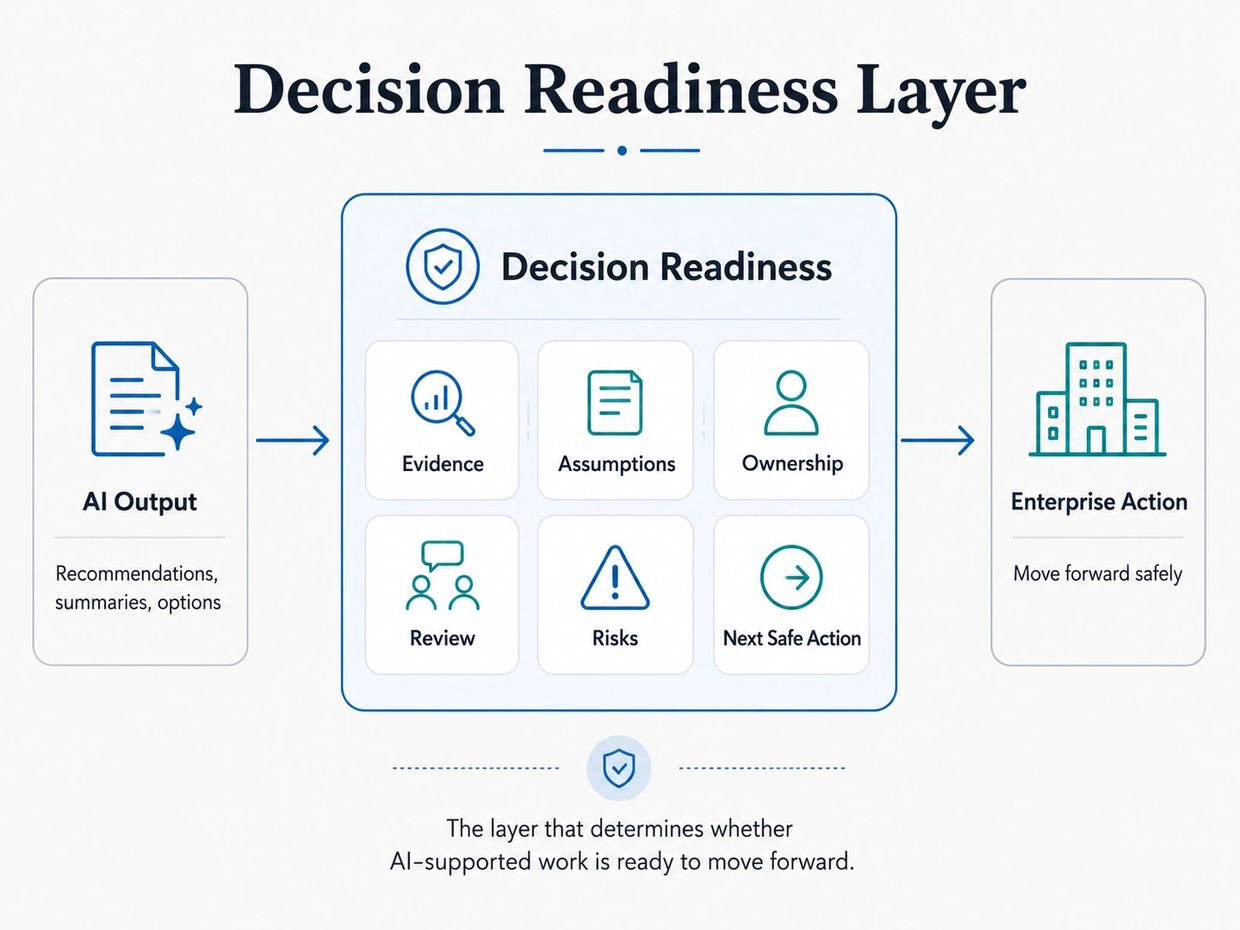
Decision readiness is the discipline of determining whether an AI-supported recommendation has enough evidence, context, ownership, review, and operational clarity to move forward safely.


AI can now generate recommendations faster than most organizations can evaluate them. That creates a new operating gap: teams may have more answers, options, and proposed actions, but less clarity about what is actually ready to move forward.


Decision readiness matters because it gives enterprises a practical way to evaluate AI-supported work before it becomes business commitment. It helps teams clarify evidence, assumptions, ownership, review paths, risks, and the next safe action so AI output does not move faster than organizational judgment.

From AI Output to Decision-Ready Action

The recommendation, summary, analysis, or proposed action generated by an AI system.

A structured business object that captures the recommendation, evidence, assumptions, options, risks, and required reviewers.

A review of whether the recommendation has enough context, evidence, authority, and clarity to move forward.

A checkpoint that determines whether the work should proceed, pause, revise, escalate, or continue discovery.

A record of what was decided, why it was decided, who reviewed it, what happened, and what should be remembered.

Future recommendations improve because teams can reuse prior evidence, outcomes, rationale, and lessons learned.

Key Concepts in Decision Readiness

Decision Packet

Decision Packet

Decision Packet

A decision packet turns an AI-supported recommendation into a structured business object. It captures the evidence, assumptions, risks, options, and reviewers needed before work moves forward.

Read the Guide

Readiness Check

Decision Packet

Decision Packet

A readiness check evaluates whether a recommendation has enough context, evidence, ownership, and clarity to proceed. It helps teams avoid acting on AI output before the organization is ready.

Read the Guide

AI Action Gate

Decision Packet

Next Safe Action

An AI action gate determines what should happen next after a recommendation is reviewed. The outcome may be proceed, pause, revise, escalate, or continue discovery.

Read the Guide

Next Safe Action

Option Evaluation

Next Safe Action

The next safe action is the smallest responsible step the organization can take now. It keeps work moving without turning an incomplete recommendation into premature commitment.

Read the Guide

Option Evaluation

Option Evaluation

Option Evaluation

Option evaluation helps teams compare possible paths before committing resources. It makes tradeoffs visible across evidence, impact, effort, risk, and readiness.

Coming Soon

Decision Memory

Option Evaluation

Option Evaluation

Decision memory captures what was decided, why it was decided, who reviewed it, and what happened afterward. It helps future teams and AI systems learn from prior decisions.

Coming Soon

AI gives answers. Decision readiness guides action.

As AI moves closer to workflows, tickets, approvals, and agents, organizations need more than output quality. They need readiness checks that determine when AI-supported work should proceed, pause, revise, escalate, or continue discovery.

Use cases

Enterprise Codex helps product teams turn customer signals, sales feedback, and AI-generated recommendations into decision packets before they become roadmap commitments. This protects engineering capacity by clarifying evidence, assumptions, options, risks, and the next safe action.
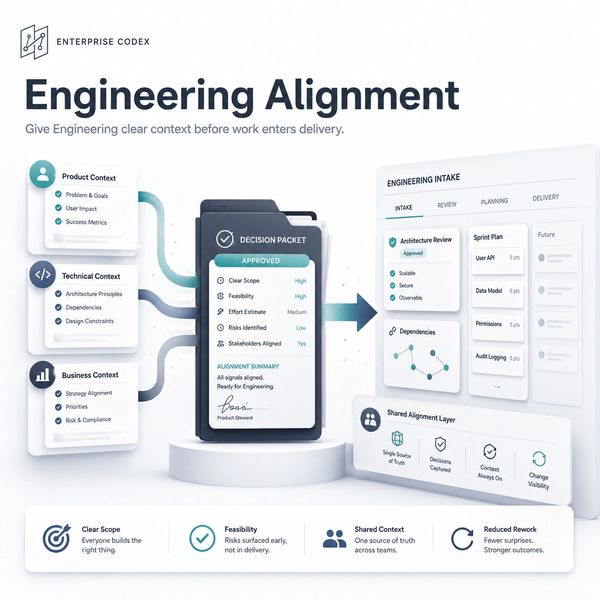
Enterprise Codex gives Engineering clearer upstream context before work enters estimation, sprint planning, or delivery. Instead of receiving vague requests, teams can see what was decided, who reviewed it, what tradeoffs were accepted, and whether the work is actually ready.
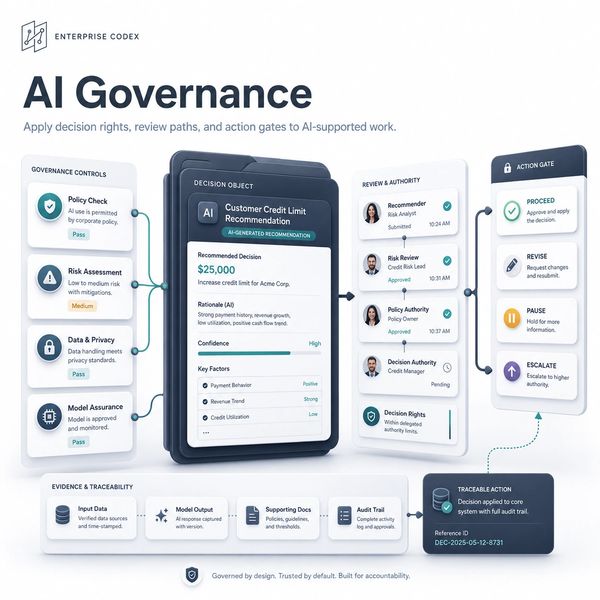
Enterprise Codex brings governance into the flow of work by turning AI-supported recommendations into reviewable decision objects. It helps teams apply evidence standards, decision rights, review paths, and action gates before AI output becomes business action.
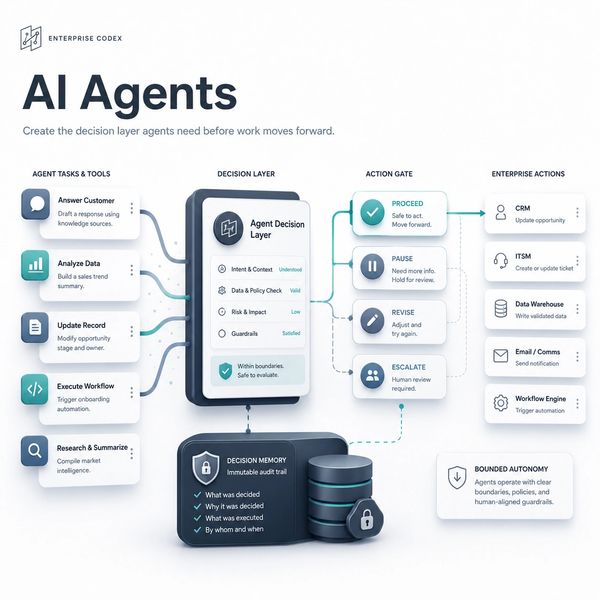
Enterprise Codex creates the decision layer AI agents need before they move work forward. It helps determine when agent-supported outputs should proceed, pause, revise, escalate, or be stored as decision memory for future use.
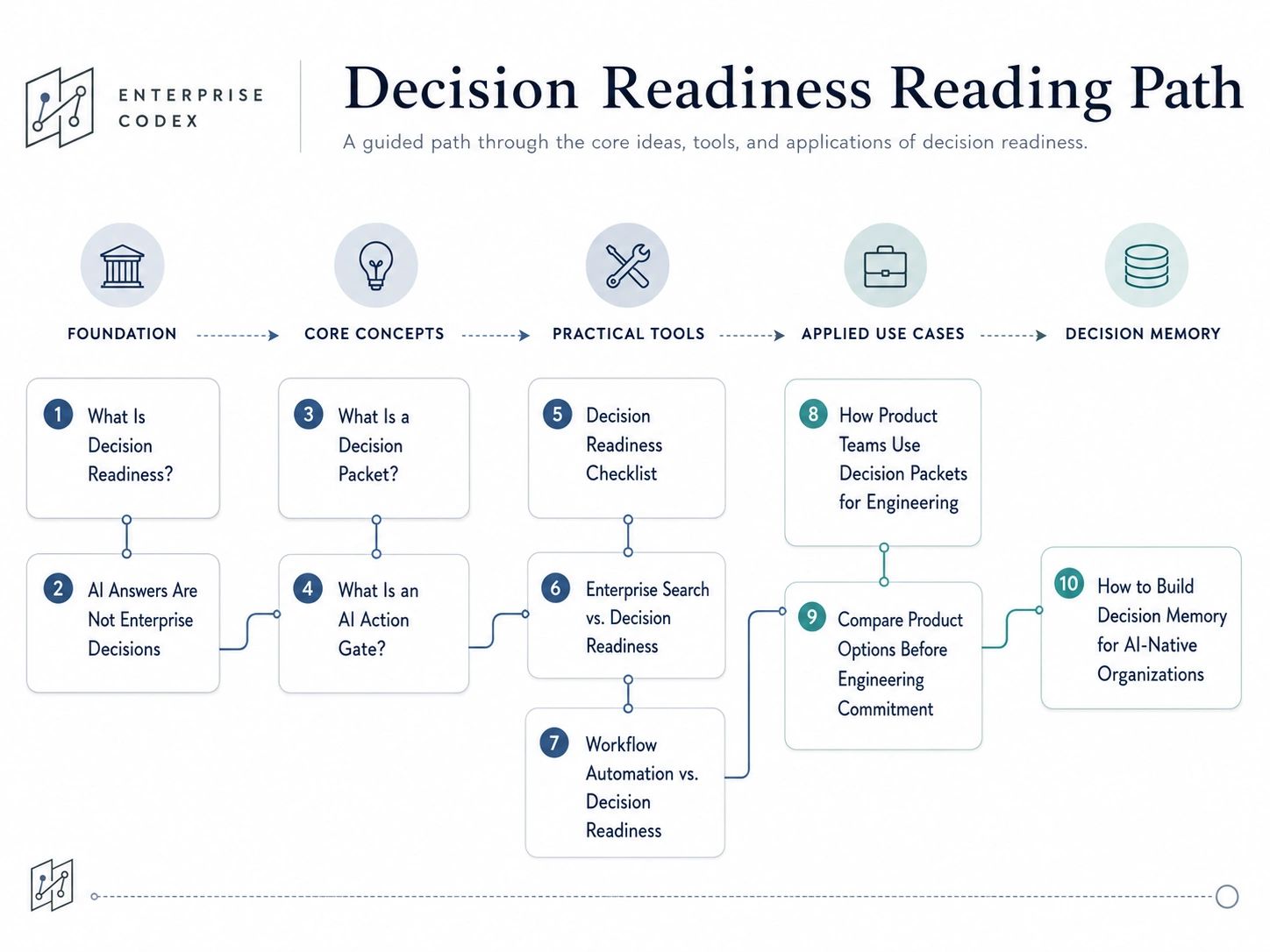
Start Here: Decision Readiness Reading Path

What Is Decision Readiness?

Start with the core concept and why it matters for enterprise AI.

Read the Guide

AI Answers Are Not Enterprise Decisions

Understand the gap between AI output and business commitment.

Read the Guide

What Is a Decision Packet?

Learn how recommendations become structured, reviewable business objects.

Read the Guide

What Is an AI Action Gate?

See how teams decide whether AI-supported work should proceed, pause, revise, or escalate.

Read the Guide

Decision Readiness Checklist

Use a practical checklist to evaluate whether a recommendation is ready to move forward.

Read the Guide

Enterprise Search vs. Decision Readiness

Understand why finding information is not the same as knowing what to do next.

Read the Guide

Workflow Automation vs. Decision Readiness

Learn why moving work faster is not the same as knowing what should move forward.

Learn More

How Product Teams Use Decision Packets for Engineering

Apply decision packets to market signals, roadmap pressure, and engineering alignment.

Guide Coming Soon

Compare Product Options Before Engineering Commitment

Compare possible paths before committing engineering resources.

Guide Coming Soon

How to Build Decision Memory for AI-Native Organizations

Capture what was decided, why it was decided, and what happened afterward.

Guide Coming Soon

Frequently Asked Questions

Please reach us at hello@enterprisecodex.com if you cannot find an answer to your question.

Decision readiness is the discipline of determining whether an AI-supported recommendation has enough evidence, context, ownership, review, and operational clarity to move forward safely. It helps teams decide whether work should proceed, pause, revise, escalate, or continue discovery.


AI answers can summarize information, recommend options, or suggest next steps, but enterprise decisions require authority, accountability, review, traceability, and operational commitment. A recommendation may be useful and still not be ready for business action.


A decision packet is a structured business object that turns an AI-supported recommendation into something the organization can review. It captures the decision statement, evidence, assumptions, options, risks, reviewers, readiness status, and next safe action.


An AI action gate is a checkpoint that determines what should happen after an AI-supported recommendation is reviewed. It helps teams decide whether to proceed, pause, revise, escalate, or continue discovery before work moves into execution.


AI governance defines policies, principles, and controls for responsible AI use. Decision readiness applies those principles inside the flow of work, helping teams evaluate specific recommendations before they become business commitments.


Enterprise search helps teams find information across documents, systems, and knowledge sources. Decision readiness goes further by helping teams determine whether the information and recommendation are strong enough to support action.


Decision readiness gives AI agents a decision layer before they move work forward. It helps determine when agent-supported outputs can proceed, when human review is required, and when the work should be paused, revised, escalated, or stored as decision memory.


Decision memory is the structured record of what was decided, why it was decided, who reviewed it, what action followed, and what happened afterward. It helps future teams and AI systems reuse prior context, reduce repeated debates, and make better decisions over time.


Copyright © 2026 Enterprise Codex. All rights reserved.
A project of Piebald & Brindle LLC.

  • Home
  • Decision Readiness
  • About
  • Advisory
  • Diagnostics
  • Essays
  • Contact

This website uses cookies.

We use cookies to analyze website traffic and optimize your website experience. By accepting our use of cookies, your data will be aggregated with all other user data.

DeclineAccept
